


Kaunas housing market: the fastest price growth in the country is no coincidence


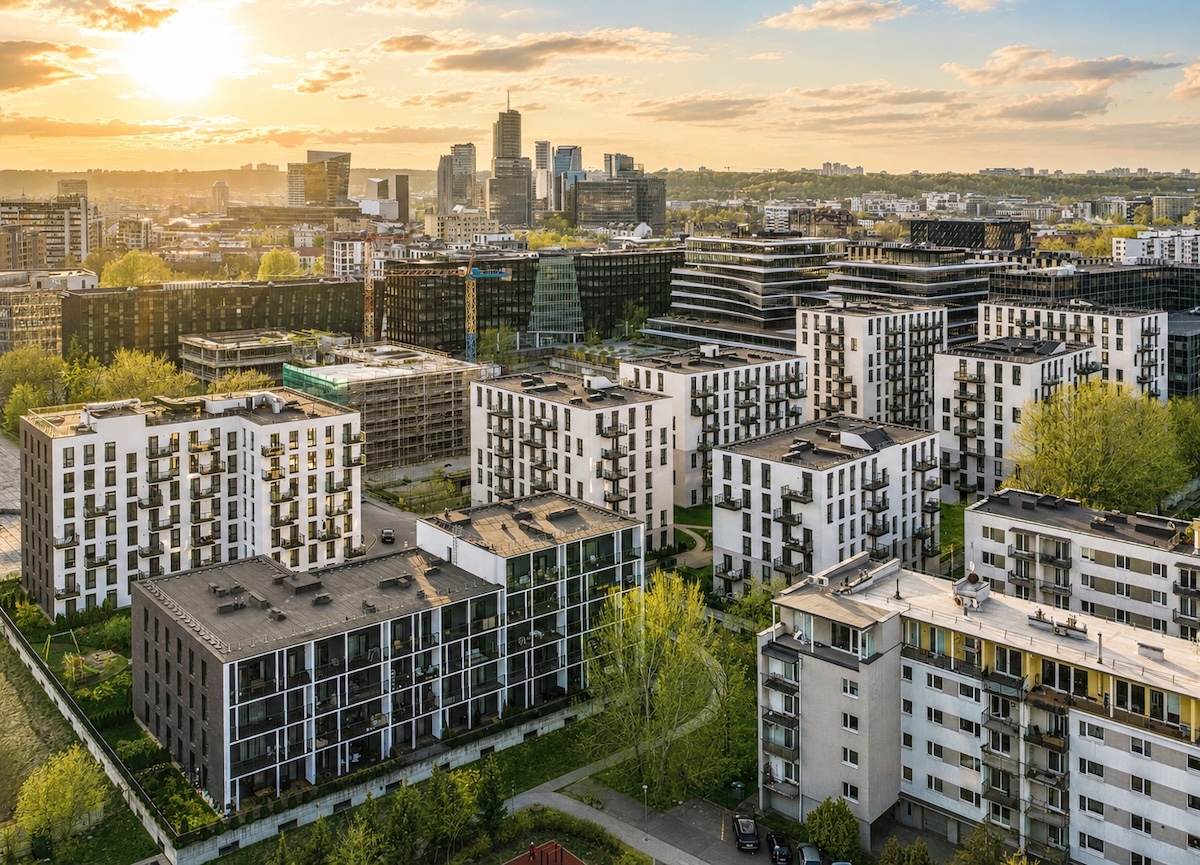
According to data from Ober-Haus, the price of apartments in Kaunas increased by 13.8% in 2025, marking the most significant change among Lithuania’s major cities. This was influenced by a limited supply of new housing, an increased proportion of higher-end projects and the renovation of old buildings.
According to the Centre of Registers, a total of 5,174 apartments and 803 houses were purchased in Kaunas in 2025, representing increases of 14% and 23% respectively compared to 2024.
According to Ober-Haus calculations, the average sale price of apartments in Kaunas at the end of 2025 was €2,071 per square metre — 13.8% higher than the previous year. This was the largest price change in Lithuania last year. By comparison, apartments in Vilnius, Klaipėda, Šiauliai and Panevėžys increased in price by 10–11% over the past year.
According to the company’s data, the price of typical old apartments in residential areas currently ranges between €1,400 and €2,400 per square metre in Kaunas, depending on furnishings, location and the condition of the building. Prices for newly built apartments with partial finishing in residential areas reach around €2,300–3,000 per square metre. In prestigious areas, the city centre or the Old Town, apartment sales prices can reach €4,000–5,000 per square metre.
Limited supply
Svajūnas Šarauskas, head of the Kaunas office of Ober-Haus, comments that the fastest rise in apartment prices in the country last year in the temporary capital is no coincidence, but was caused by increasing construction costs and stricter requirements.
‘Kaunas still lacks high-quality new housing in convenient locations, especially two- to three-room apartments, so demand currently far exceeds supply. For example, the number of apartments built in Kaunas has declined for two consecutive years,” says Šarauskas.
He mentions the alternatives favoured by residents in the suburbs, primarily in the Kaunas district, where people are building cottages and houses to gain more space and their own land at lower prices. The development of the Kaunas district has contributed to a slight decline in the city’s population in recent years, which may dampen the enthusiasm of new housing developers and consequently reduce supply.
‘Although we see quite a few people who have “had enough” of the district and are looking for more spacious apartments in the city centre again, it is likely that it is precisely this specificity of the Kaunas region that determines the slower pace of new construction in the city. I believe that Kaunas should strive to create better conditions for developing housing attractive to families and the middle classes in the city itself, as large-scale migration to the suburbs is already creating political and economic tensions, and the Kaunas district is becoming the fastest-growing municipality in the country,’ comments Šarauskas.
The Ober-Haus representative also pointed out that, last year, Kaunas saw a relatively large number of high-end projects in the riverside and central areas. This contributed to the increased price range for housing.
‘The Kaunas market itself remains active. Secondary market sales should continue to dominate the city, although we are seeing developers return to the market with new projects after a few years’ absence. Currently, the most popular properties are two- to three-room apartments (45–70 sq. m) with rational layouts, large balconies or terraces, storage rooms and parking spaces. Convenient daily logistics, green spaces, a closed, secure courtyard, infrastructure for children and low maintenance costs are the most important factors for buyers. People also increasingly value the emotional side of a project – they want to live in an environment where they can play sports, socialise and raise children, not in a ‘sleeping district’,” says S. Šarauskas.
What is being built, and what are the prospects?
According to data from Ober-Haus, the supply of new constructions in Kaunas is supported by projects that have been developed in stages over several years. Examples include Piliamiestis, Nemunaičiai, Kaunorama, Pušų Apartamentai and Namučiai. They will be joined this year by the Matau Kauną, Radio City and Ąžuolyno Uoksai projects in Šančiai, which are already under construction or in the planning stages. According to S. Šarauskas, this complex deserves special attention as it reflects new trends in Kaunas.
‘Firstly, Ąžuolyno Uoksai is changing the standard in Šančiai. This part of the city is evolving from an affordable, transitional area into a place that is increasingly attractive to the middle class, young professionals, and families. A unique feature is the planned swimming pool in the neighbourhood of the apartment block,” says Šarauskas.
He notes a growing demand for quality of life, security solutions, technical aspects, and the environment among buyers throughout the city.
‘All this shows that Kaunas residents are no longer only concerned with the price-to-space ratio, but also with everyday comfort, pedestrian accessibility, and community spirit.’ Residents expect new neighbourhoods to be more than just residential areas; they want them to be full-fledged parts of the city with services, jobs, and public spaces. In addition to the aforementioned projects, the Tesonet Group’s planned neighbourhood on Minkovskių Street, which will include a business centre, hotel, and apartments, should set a similar trend in Kaunas,’ says the Ober-Haus representative.
He mentions Vilijampolė, Žemutinė Freda and the former Kaunas Grain territory stretching along the river as among the Kaunas districts that are currently undergoing active development and have further potential. Within the city, future development can be seen in Naujamiestis, while the industrial areas of Volfas Engelman and Stumbras have conversion potential. Aleksotas is also being analysed.
‘In the longer term, I would not be surprised to see attention focused on Jonavos Street, which runs alongside the banks of the Neris River. This would require substantial investment, conversion and the complex revitalisation of residential and industrial areas, but it is already an attractive, long space with natural potential,” says S. Šarauskas.
Rental ceilings
Ober-Haus specialists recorded an annual increase in prices of 9% in the rental market last year. The average rental price per square metre in Kaunas is currently around €12 per month.
The rental price for a two-room apartment in residential areas of Kaunas is currently €360–600 per month, and in the city centre, it is €420–800 per month. S. Šarauskas already sees a certain ceiling in the rental segment, which is further reinforced by the city’s stagnant population growth.
‘The rental market should remain stable. There are around 500 apartments available, so tenants will have plenty to choose from. Although landlords have high price expectations, customers are bringing them back down to earth,” says Šarauskas.
According to the data, two-room apartments are the most popular to rent in Kaunas, followed by one-room apartments. Traditionally, the highest level of rental activity is associated with students at the end of summer and in autumn.
Latest news
 All news
The housing market remains active,…
The Ober-Haus Lithuanian apartment price index (OHBI), which follows changes…

Lithuania/Vilnius Real Estate Market Report…
We present the annual Lithuania (Vilnius) Real Estate Market Review…
Ober-Haus achieves highest turnover in…
Audrius Šapoka, CEO of Ober-Haus. Photo by Judita Grigelytė (“VŽ”).…
All news